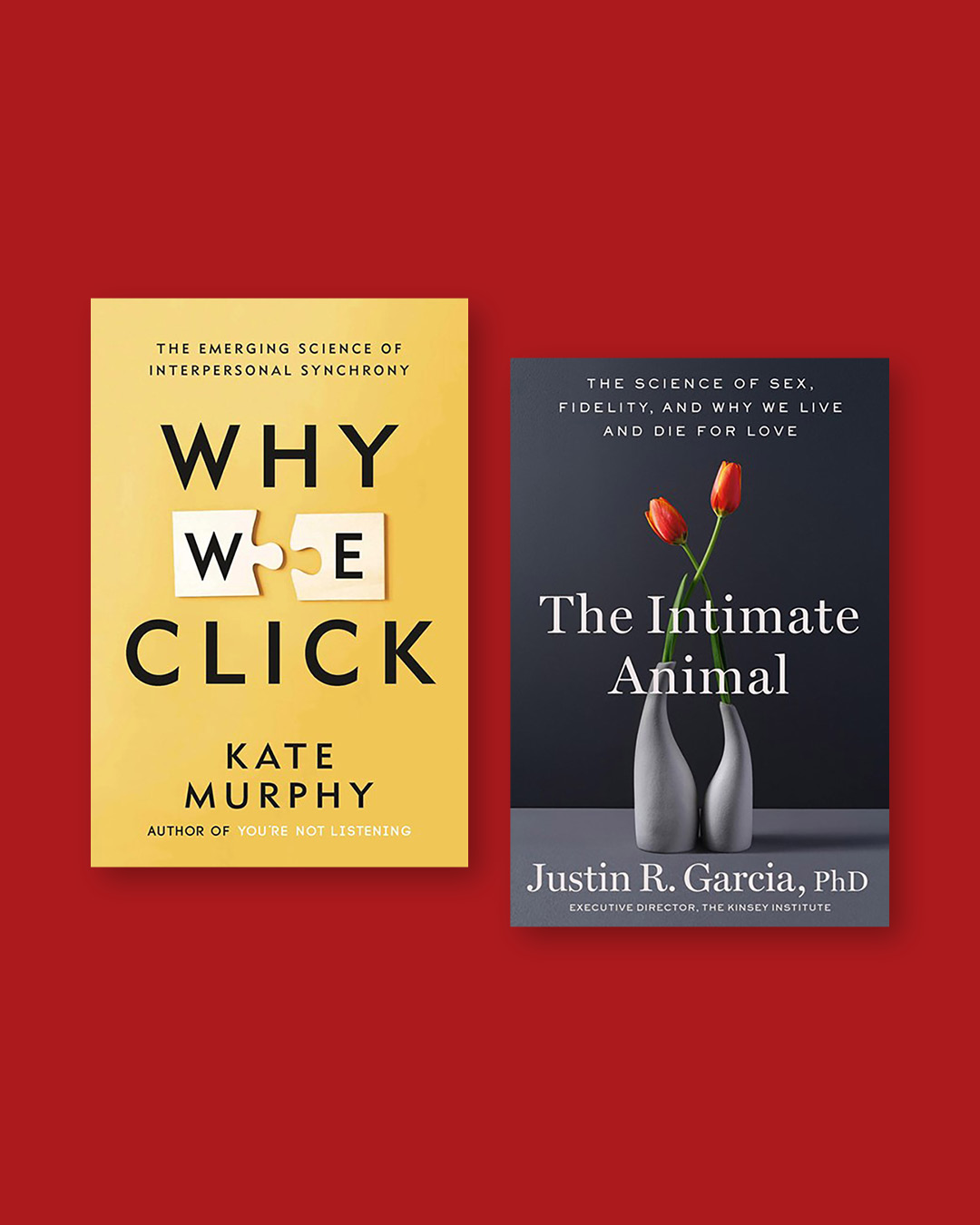
Why We Click
Kate Murphy (You’re Not Listening) brings a reporter’s verve to her second book, Why We Click: The Emerging Science of Interpersonal Synchrony, which examines how and why we’re drawn to one person but repelled by another. “Interpersonal synchrony is the seemingly magical, yet scientifically documented, tendency of human beings to fall into rhythm with one another,” Murphy writes. Scientists are finding that this rhythm goes beyond body language to physiological changes like heart rates, blood pressure, brain waves, pupil dilation and hormonal activity.
Murphy looks at synchrony from many angles, including her experience with two neighbors, one who engages and transforms others, and one who drags others down. She gets into the science of attraction—what researchers have learned by studying speed daters and couples—and of group dynamics, in which a group of people, like co-workers, may sync with one colleague and unconsciously mirror their behavior. And she looks at syncing with animals and inanimate objects, like fighter jets, as well as at the possibility that quantum physics may have something to do with synchrony.
A longtime contributor to the New York Times, the Wall Street Journal and Texas Monthly, Murphy sets scenes well, with a vivid sense of place and character. Her chapter on syncing with nonhumans includes a close-up of Buck Brannaman, the inspiration for Nicholas Evans’ The Horse Whisperer, who is so in tune with his horses that he coaxes them into complex rhythmic dances. She brings scenes to life with unexpected detail and peppery quotes: “When you’re not in tune with your horse, it’s like dancing with a drunk,” Buck tells her.
Though Why We Click isn’t self-help, it does delve into the drawbacks of too much interpersonal synchrony, as in when you’re sucked into a friend’s drama, with strategies for avoiding this unhelpful synchrony. Murphy also details what we’ve lost, citing the disconnection of today’s Zooms, remote work and frictionless shopping: “We have a profound instinct to sync, but there’s a lot interrupting, intercepting, or degrading the signals we send and receive,” Murphy notes, arguing for spending more time, rather than less, in the presence of our fellow humans.
Why We Click is an approachable mix of science writing, social psychology and journalism. Murphy draws from psychological studies and experiments both contemporary and centuries-old, scenes from New York City’s Comedy Cellar and Christie’s auction house, interviews with high-powered defense attorneys and neuroscientists, and much more. Grounded in deep research, Why We Click is an accessible, satisfying study that will change the way readers understand themselves and their world.
—Sarah McCraw Crow
The Intimate Animal
Did you know the most expensive service at a legal brothel in Pahrump, Nevada, doesn’t necessarily involve sex? Called the White Whale, or full Girlfriend Experience, this “one hell of a cuddle,” according to a brothel staff member, starts at $20,000 and is a favorite among Vegas’ high rollers.
In The Intimate Animal: The Science of Sex, Fidelity, and Why We Live and Die for Love, evolutionary biologist and sex and relationships researcher Justin R. Garcia uses this example and many more to outline the significance of intimacy in our everyday lives and the bonds we create with others, particularly on a romantic and sexual level. Divided into chapters with categories such as Need, Crave, Search, Nest, Stray and Care, the book highlights aspects of the “biological, cultural, psychological, social, and ecological forces that come into play over the life cycle of our intimate relationships.”
As executive director and senior scientist at the Kinsey Institute (long recognized for its groundbreaking interdisciplinary research on human sexual behavior), Garcia’s expertise is a perfect complement to his writing. With a style accessible to the lay reader, he summons scientific studies, anthropological research, historical references and examples from popular culture to provide evidence of the importance of intimacy to the evolution and continued survival of the human race. Delving into the human evolutionary process, he explains how “pair bonding” developed around the same time as our ancestors became bipedal and why humans adapted this concept to become socially monogamous, since this two-parent unit was advantageous to raising children.
But there’s a paradox. “Humans are wired to be socially monogamous—that is, we have a remarkable capacity and desire to form intense pair bonds with other humans, usually one at a time, and sometimes lifelong—but we are not necessarily wired to be sexually monogamous.” To help understand why, Garcia looks at our drive for self-expansion, the rise of hookup culture and the role that risk plays in selecting a mate. He also focuses on the modern and technological changes that affect intimacy, such as the proliferation of social media dating apps and the ramifications of the COVID-19 lockdown and social distancing.
The Intimate Animal is a fascinating look into the importance of intimacy and our need for meaningful relationships, and a helpful handbook for anyone wanting to understand their own relationship patterns.
—Becky Libourel Diamond