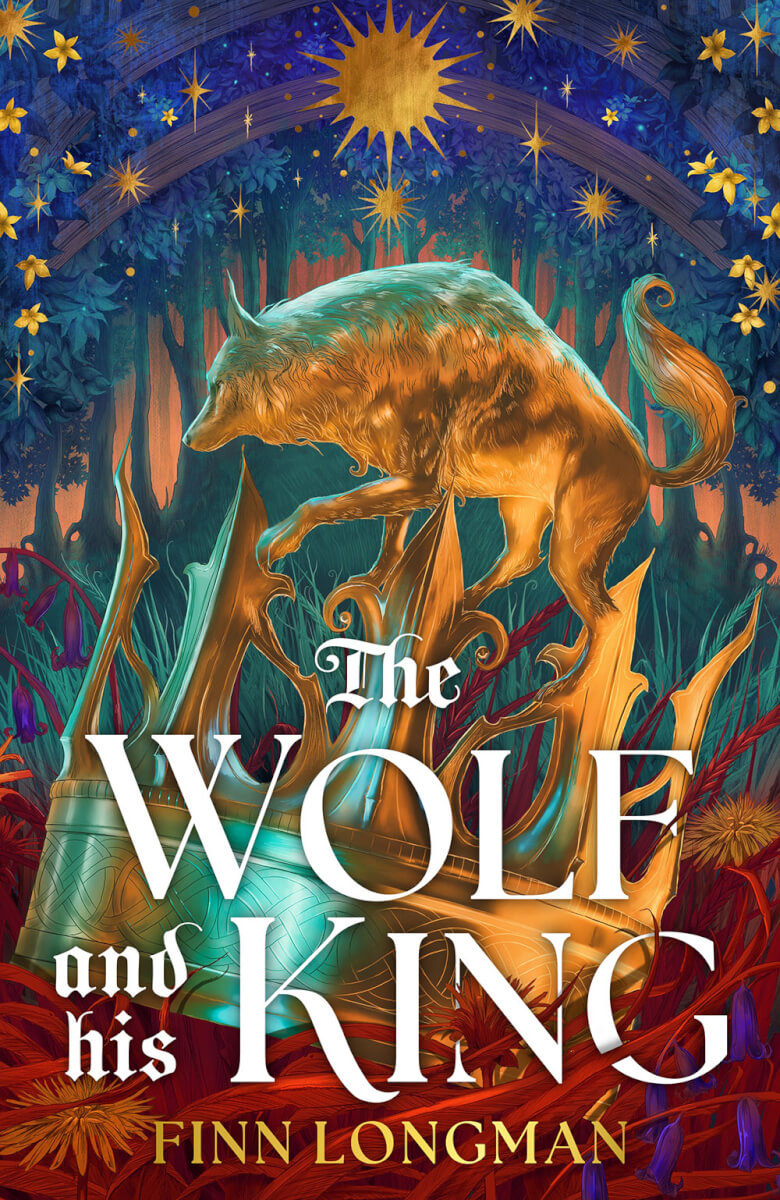
Finn Longman’s The Wolf and His King is a magnificent literary tale born of medieval roots and nurtured in a lush fantasy realm. Based on the 12th-century tale “Bisclavret” (“The Werewolf”), a short narrative poem or “lai” by Marie de France, Longman’s eloquent reimagining of the tale presents a queer reading of a man battling the wolf-monster within. While the young nobleman Bisclavret undergoes bodily changes at the whim of the moon cycles, Longman excels in exploring the intricate, fluctuating interpersonal dynamics between him and the rest of the cast of unnamed characters. Most notable is the young king, whose romantic and physical longing for the cryptic, handsome nobleman creates tension thick enough to slice with a sword. Longman has taken the lai’s plot and woven a detailed rendition that is emotional and thought-provoking, infusing the original tale with additional layers of secrets, lust, family histories and societal pressures.
Longman, a medieval scholar themself, stays true to the narrative of Marie de France’s work, expanding on the poem’s plot in a way that pays homage to the original while lending dimensionality to these figures. Bisclavret has been convinced by his cousin to seek an audience with the newly crowned king to restore his father’s good name and claim his family’s land after years of exile. Bisclavret is understandably cautious, being a sometimes-wolf who cannot control himself when changed, and initially tries to convince his cousin, who knows this secret—and the king, who doesn’t—that a position in the royal court is a bad fit for him. But once Bisclavret begins to experience life as a favorite of the king, it becomes more difficult to reject the professional, political and romantic opportunities that present themselves, even if people are starting to grow suspicious about his propensity for random bouts of mysterious “illness.”
The chapters alternate among a unique set of perspectives: Bisclavret in third person, the king’s point of view in second person and an unnamed third perspective that develops throughout the tale. Through these alternating perspectives, Longman defies traditional conventions of verse and occasionally conflates poetry and prose. This melding of language mirrors the plot as Bisclavret begins to lose his grip on control when he is in wolf form. That said, Bisclavret is easy to root for, both in rising in the ranks of the king’s court and in his romantic conquests. While there are romantic and intimate overtones in the book, The Wolf and His King is the epitome of a slow-burning emotional romance, as Bisclavret and the king excel in smoldering looks, feverish thoughts and the very art of yearning itself. As the political and personal stakes heighten and Bisclavret’s control over his inner werewolf lessens, the ambitious young nobleman is compelled to make life-altering decisions about loyalty, identity and love.