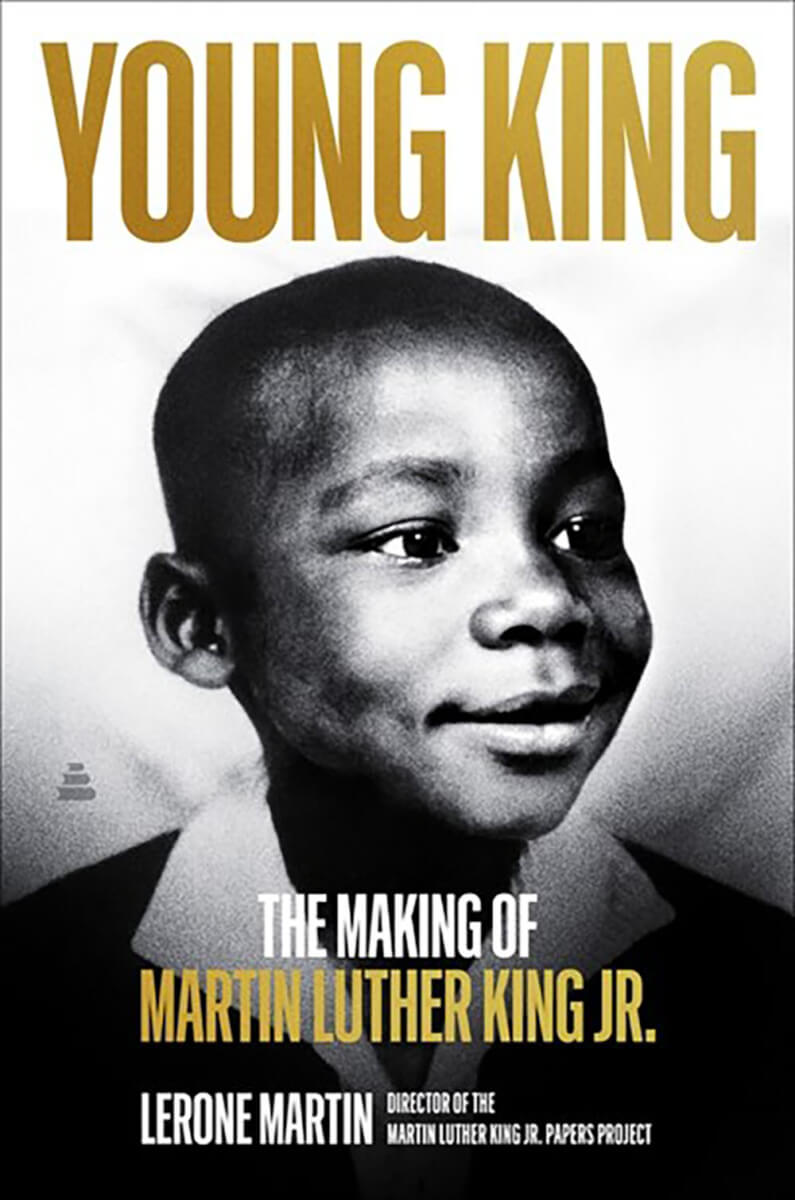
We know Martin Luther King Jr. as the dynamic minister and activist whose leadership during the Civil Rights Movement led to the passage of landmark legislation that brought all Americans closer to equal rights. But how did he become this towering figure? Lerone Martin, professor of religious studies and director of the Martin Luther King, Jr. Research and Education Institute at Stanford University, tells us in his deeply researched, enlightening Young King: The Making of Martin Luther King Jr.
Aiming “to strip Reverend Dr. King of the iconic status that adorns him today and allow him to simply be an adolescent,” Martin paints a portrait of a sensitive, playful child raised in a loving family. The son of a prominent Atlanta minister, King was raised in relatively comfortable but segregated circumstances. He was strongly influenced by the church and, later, the poetry of Langston Hughes. His early discovery of the color line led to confusion, heartbreak and anger as his “world was becoming eclipsed by racism.” But the love of his parents and extended family “helped to inoculate him against ultimate hatred and despair.” All the while, King became determined to do something to combat racism but was uncertain for many years how he would do it.
Change came in 1944, when he worked in the tobacco fields of Connecticut to help pay his college expenses. He enjoyed his time there, where segregation did not control his life, and he had time off to explore the area beyond where he worked. Calling the Connecticut Valley “God’s country,” King’s teenage agnosticism turned to belief, and he found his first congregation among his co-workers. He began to feel, writes Martin, “one of childhood’s most precious but precarious luxuries: hope.” Later, Andrew Young, King’s close friend and aide, said if King had not had this experience, he may never have become the King we know today.
Martin spends due space on King’s time at Morehouse College, a guiding light and tremendous influence. Allowed to skip grades in an under-resourced school system, King entered as a 15-year-old freshman in the fall of 1944. He struggled academically, but found an outstanding mentor in George D. Kelsey, whose theology course convinced King to become a minister. The biography culminates in King’s enchanting meeting with Coretta Scott, whose love and politics would further influence his life.
This revealing, vividly told biography illuminates a fact worth remembering: Our greatest leaders do not emerge fully formed in the moment in which they are most needed, but are molded by family, community and education. Martin’s captivating Young King shows how these influences and experiences “coalesced to produce a man, a minister, and a dreamer who changed the world.”