
There is a side of Despina Mirou that deserves far more attention.
Audiences may know her for comedy, her extraordinary ability to transform herself into famous personalities, or the larger-than-life energy she brings to entertainment. But behind all of that is something much deeper: a classically trained dramatic actress whose first love has always been the stage.
Mirou isn’t simply a performer who occasionally takes dramatic roles. Drama and theater are embedded in the foundation of her career.
“I am addicted to the stage,” Mirou has said. “I started from the stage. I put theater first, then cinema and television.”
That statement explains a great deal about the actress she has become.

Drama Came First
Before Hollywood, before international film productions and before audiences discovered her gift for comedy and impersonation, Mirou was developing her craft through theater.
Her stage experience includes demanding classical and dramatic material, with performances in works associated with writers including Anton Chekhov, Aeschylus, Jean Genet and Oscar Wilde. She has tackled characters such as Cassandra in Oresteia and Sonya in Chekhov’s Uncle Vanya.
These aren’t roles an actress can simply charm her way through.
They demand discipline.
They demand emotional intelligence.
And, most importantly, they demand truth.
Mirou’s theatrical background taught her how to build a character from the inside rather than simply perform one from the outside. That’s a skill that becomes particularly visible when she moves into dramatic material.

The Power to Become Someone Else
Perhaps Mirou’s most impressive quality as an actress is her ability to transform.
Some performers carry their own personalities from role to role. You always know exactly who you’re watching.
Mirou can disappear.
She can be elegant and sophisticated in one performance, vulnerable and wounded in another, intimidating in the next and completely outrageous when comedy calls for it.
That versatility is rare.
It also explains why her dramatic performances can be so effective. Mirou isn’t afraid of complicated women. She seems drawn to characters who have contradictions—strength and vulnerability, darkness and humor, confidence and fear.
Those contradictions make characters human.
And Mirou understands how to find them.

Trained by the Stage, Challenged by the Greats
Mirou’s journey has also brought her into contact with some extraordinary figures in cinema and theater.
She participated in an acting masterclass with Al Pacino connected with Salome and studied with respected acting teacher John Strasberg. Her career has also placed her in productions connected with internationally recognized filmmakers and artists.
But teachers and famous collaborators can only take an actor so far.
Eventually the actress has to stand in front of the camera—or walk onto a stage—and deliver.
Mirou does.
The discipline she developed in theater gives her dramatic performances a different texture. She understands silence. She understands that sometimes the most powerful moment isn’t a scream or a tear but what a character refuses to say.
That’s the difference between performing emotion and actually making an audience feel it.

More Than Comedy
Mirou’s comedic talent can sometimes disguise just how serious her acting background really is.
Comedy requires extraordinary timing, confidence and instinct, and Mirou possesses all three. But drama allows audiences to see something different.
Strip away the impersonations.
Strip away the punchlines.
Strip away the glamour.
What remains is an actress capable of vulnerability.
And vulnerability is where great dramatic performances live.
Mirou’s ability to move between comedy and drama shouldn’t be surprising. Many of the finest dramatic actors possess an instinctive understanding of comedy because both forms depend upon exactly the same thing: truth.
If an audience doesn’t believe you, neither works.

A Woman of Many Faces
Mirou has become particularly known for her remarkable transformations into iconic women, including figures such as Marilyn Monroe, Elizabeth Taylor, Sophia Loren, Ava Gardner and Joan Crawford.
But physical transformation is only the beginning.
Anyone can put on a costume.
A dramatic actress has to discover what happens when the costume comes off.
What did these women fear? What did they want? What happened when nobody was watching? Where did their confidence end and their insecurity begin?
Those are the questions that turn impersonation into acting.
And they are exactly the kinds of questions Mirou’s theatrical training prepared her to explore.
With Marilyn Monroe, for example, recreating the famous image is one thing. Finding the vulnerable woman behind that image is something entirely different.
The photograph gives you Marilyn. The actress has to find Norma Jeane.
That’s where Mirou can shine.
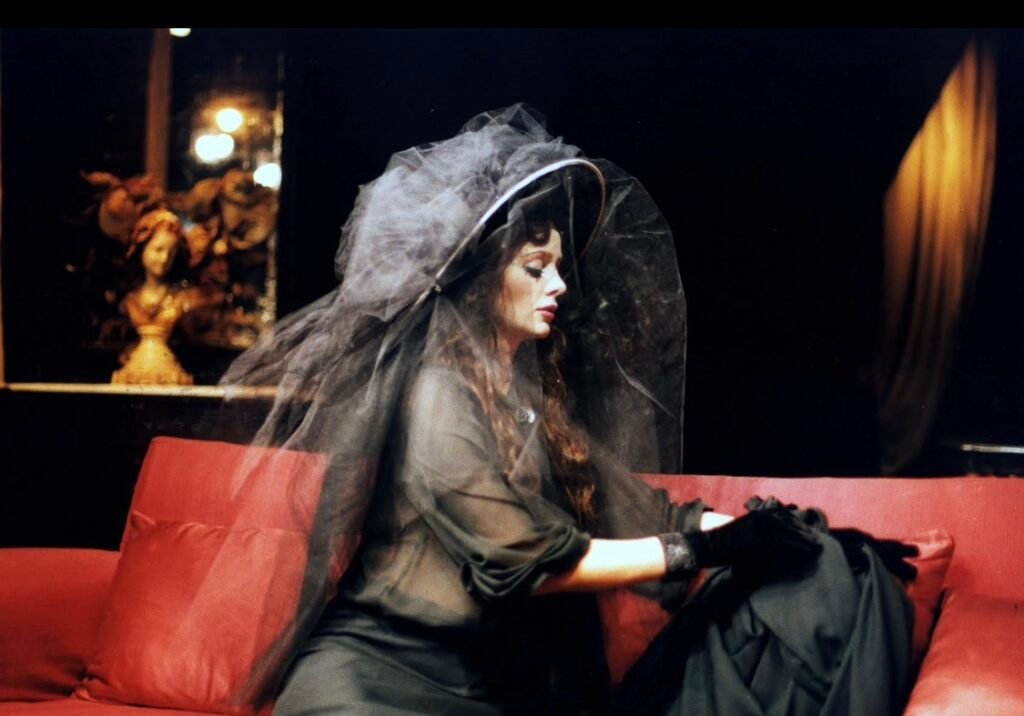
The Actress Behind the Personality
There is an interesting paradox at the center of Despina Mirou’s career.
She has a huge personality, yet some of her strongest work happens when she makes that personality disappear.
She can command attention simply by entering a room, but dramatic acting asks her to surrender that power to the character. Instead of asking audiences to watch Despina Mirou, she has to convince them that Despina Mirou isn’t there at all.
That ability to disappear is one of the hallmarks of a serious actor.
Her European theatrical background, years of stage work and experience across film, television and comedy have created an actress with an unusually broad emotional vocabulary.
She’s funny because she understands timing.
She’s theatrical because she understands presence.
She’s dramatic because she understands emotion.
And she’s compelling because she isn’t afraid to transform.

Despina Mirou Is a Dramatic Actress
It would be easy to describe Despina Mirou as an entertainer, comedian, impersonator or international actress.
All of those descriptions are true.
But none of them tells the complete story.
At her core, Despina Mirou is a dramatic and theatrical actress.
The stage came first. The training came first. The characters came first.
Everything else grew from there.
Her ability to make audiences laugh may be one of her most immediately recognizable gifts, but her ability to make them believe, feel and occasionally hurt with a character reveals something more substantial.
Give Despina Mirou a great dramatic role and she doesn’t need an impersonation, a punchline or a famous face to hide behind.
She only needs the character.
And when the lights come up, that’s exactly who she becomes.