In 2023, Marlon James—Booker Prize-winning novelist, dynamic screenwriter and lifelong visual artist—needed a change of course. One year earlier, Riverhead had published Moon Witch, Spider King, his fifth novel and the second installment of his Dark Star Trilogy, a fantasy series inspired by ancient African history and mythology. James wanted to take a detour before completing the series; he also wanted to write something more contemporary. Six hundred pages later, The Disappearers was complete. “The thing is, I thought this was going to be a really short novel, and then I’d go back to writing the trilogy,” he tells BookPage on a video call. “This is not a lie. I wrote it and I thought, ‘Yes, damn it! I finally did a short one.’ Then I realized I wrote it in 10-point [font],” he says, laughing.
James is a warm, witty conversationalist, fond of gentle sarcasm. “I’m a typical writer cliche, living in Brooklyn,” he says glibly before gesturing to a piece of art hanging behind him and explaining that he is in his drawing studio, “hence the naked man.” A full professor at Stony Brook University as of August 2026, James has an encyclopedic knowledge of literature, movies, quotes from famous authors and good music. It’s easy to see how much of his personality shines through the pages of The Disappearers, right down to its song references (which you should definitely listen to if you’re unfamiliar). The main characters, who tell the story of a catastrophic event that forever changes their lives in 1980s Kingston, Jamaica, are a lot like their creator. Eddy Porteous loves poetry and the artist who will forever be known as Prince. Jordan Brown is a bibliophile who can match Eddy’s literary references quote for quote, and is obsessed with the grunge band Nirvana. Havelock Titus, a dandy with a penchant for bawdy tales, appreciates the finer things in life, even if he can’t always afford them. Each of the characters is as carefully rendered as the sketches tacked to James’ studio walls, all of which he drew himself. (“I stopped [making] art for a while,” he tells me. “I’m trying to rediscover that part of myself.”)
The Disappearers is a masterfully crafted book, but make no mistake: It is, at times, a harrowing read. And yet, like my conversation with its author, I found it difficult to walk away from once I was done with it, and I have not stopped thinking about it since.
When James set out to write The Disappearers, he started from a story that was close to his heart. The novel is about an unsolved crime that, for several decades, has been the subject of rumor in Jamaica, where James was born and lived until his mid-30s: a mob attack on a group of gay men. “For a lot of people I know, this would have been their first novel,” says James. “Maybe not as big as this, but the one that hits closer to home, the one where the characters’ stakes are my stakes. And I was never interested in doing that for a first novel, or a second, or a third. But I knew I was going to come back to it at some point.”
In May 1988, Eddy, Jordan and Havelock, along with five other actors, begin rehearsals for the play Fortune and Men’s Eyes, written by gay Canadian playwright John Herbert about his experiences in a youth reformatory. While the eight men are initially strangers to each other, they share the experience of fighting to survive the ubiquitous homophobia of 1980s Kingston, where something as simple as a lingering stare or as mundane as buying a Prince album could spell doom—either at the hands of your neighbors, or of the authorities who are supposed to protect you.
James has witnessed the shocking, swift violence of a Jamaican mob. “Your only way out was to run to the police and have the police beat you instead. Because at least the beating won’t end in death. They just beat you enough to satisfy the mob and, you know, you try to heal.”
“If you’re doing the monstrous enough, even if you feel you’re justified, eventually you’re going to become a monster.”
The actors have only been rehearsing for a few weeks when a mob that includes policemen and a famous dancehall DJ descends on the playhouse. All of them are beaten. One is permanently disabled. Another dies. Eddy, the first of several narrators of the story, misses rehearsal that day and is spared, but he does not go unscathed. Still, “he thinks, in the face of actual violence, his trauma is meaningless,” says James. This particular pain is familiar to the author, who says Eddy’s experience is similar to his own, and common to many.
“I was never the victim of a mob,” he says. “I was never—and I still haven’t been—exposed to any form of violence. But I have been exposed to being so excluded that I think my life isn’t worth anything. The gay teenagers who are killing themselves . . . aren’t people who are being beaten all the time. It’s people who experience extreme rejection at the exact point when you need connection.”
At the heart of The Disappearers is a question: How do these myriad forms of violence change you? In each of the novel’s five sections—Eddy’s diary entries, the testimonies of the attackers, Jordan’s search for justice, Havelock’s letters to his longtime friend and former pimp, and finally the account of a character whose identity is only revealed in the final pages—the men must face what violence has forced them to become. Eddy scrambles to find and help several of the men who have gone missing after the attack. Jordan spirals but ultimately settles on revenge. As he systematically hunts down his assailants, he loses more and more of himself to his own cruelty. Jordan’s trajectory is one James admits he’s fascinated with. “I say this as somebody who writes a lot of violence: We’re not wired for violence as people, no matter what we think. If you’re doing the monstrous enough, even if you feel you’re justified, eventually you’re going to become a monster.” Others from the group leave Jamaica altogether or disappear into religious communities and sexual repression.
Across the range of these men’s experiences, we also see the stratification of Jamaica’s queer community. When Eddy and Jordan team up to locate the missing men, they find themselves in gay bars and speakeasies, in the sprawling home of government ambassador and child pornographer Paul Royale and in the gutters of Jamaica’s underground, where gay, trans and gender-nonconforming people take care of each other with limited resources and under constant threat of death. This community, affectionately referred to as the “gully queens,” is pivotal to Eddy’s and Jordan’s survival, even though the queens themselves are some of Kingston’s most vulnerable citizens.
“These are the queer people who didn’t get absorbed by class,” James says. “These people are kicked out of houses that could barely hold them in the first place. They’re on the streets . . . so many of them are doing sex work. The thing about sex work, especially in Jamaica, is that you get to see people—and by people, I mean men—at their worst and as they really are. This is why sometimes a gully queen will say they had an encounter that started out with sex and ended in violence. Because whoever sleeps with them wants to destroy the memory of it.”
“One of the things I learned from Morrison is not to be afraid to put the character and the reader in an uncomfortable situation.”
Yet, in spite of this vulnerability, the gully queens are generous and caring. Here, Eddy and Jordan have their first up-close encounter with a man who is dying of AIDS: Roderick Crawford. Like Eddy, Roderick is fair-skinned and upper-middle class, and as James points out, he would never have interacted with the people who live in the gutters under Kingston’s streets if his family hadn’t abandoned him. Even after the end of colonialism, class and color still play outsize roles in Jamaica’s delicate social structure. Queerness and illness, however, can muddle those lines, making for unexpected friendships, found families and final caregivers. “Class still makes the difference,” James says. “Roderick in his prime would have never seen a Martinique [one of the gully queens] ever. So, it’s ironic that these are the people who end up taking care of him.”
In its many twists and turns, The Disappearers is a novel that upends allegiances, complicates the meaning of necessary violence and defines and redefines what it means to be a victim, an abuser and an ally. When I ask James about the difficult choices both his characters and his readers must make, his answer is simple: Good work pushes boundaries. “Not that I do it deliberately,” he says. “But I do like when a book pushes you to take sides you don’t want to take or complicates a character you don’t want complicated. The problem is, I read Toni Morrison novels, and Toni Morrison always puts you in a hard choice. In Sula, when [Eva Peace] burns her son to death, I mean . . . was it an act of cruelty? Yes. Does she really think that’s the only way she could save her son? Also yes. One of the things I learned from Morrison is not to be afraid to put the character and the reader in an uncomfortable situation.”
It is no hyperbole to say this book will change you. As I watched Eddy and Jordan grow into complicated men while Havelock does his best to maintain a sense of gentility that flies in the face of the harm he survived, I found myself wondering about my own sensibilities and how they have been shaped, not by the violence that plagues the lives of many people—myself included—but by the ways violence is often glossed over or completely left out in literary fiction. The Disappearers goes a long way to push against those conventions, and the emotional journey of this story, with all its shock and awe, sex and brutality, and moments of self-discovery and erasure have made me a more omnivorous reader and a less apologetic writer of these same subjects.
Near the end of our call, I asked James what he wanted readers to know about the book, and his words echo my own sentiments. “Even I know my books can be hard,” he says. “But I like to think you’re rewarded. I’m taking you to a lot of places and we’re not gonna end up anywhere near the place we began. I know I learned some things writing it. I hope you learn some things reading it. I hope you fall in love with people who you would have never thought you’d ever fall in love with.”
Read our starred review of The Disappearers.
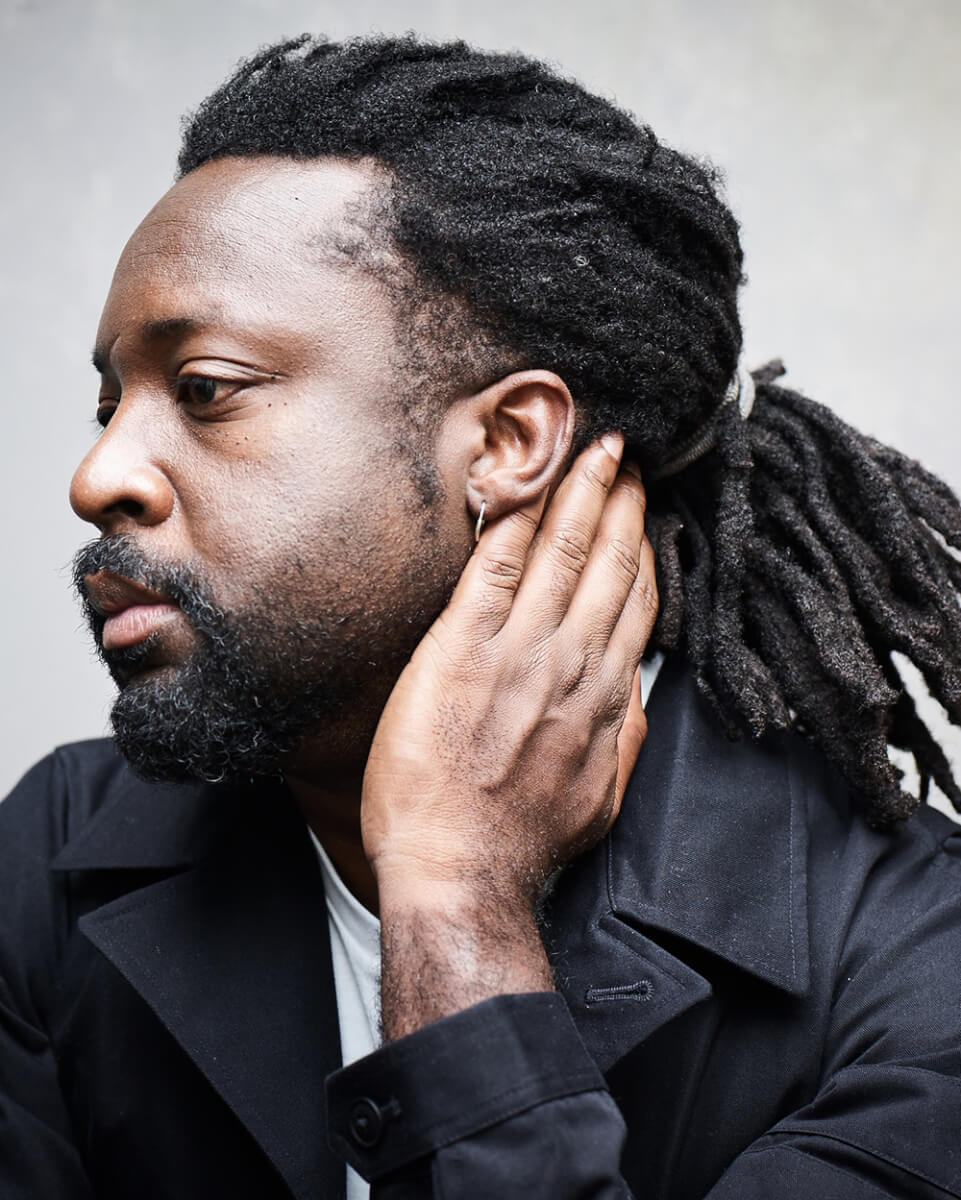
Photo of Marlon James by Mark Seliger.