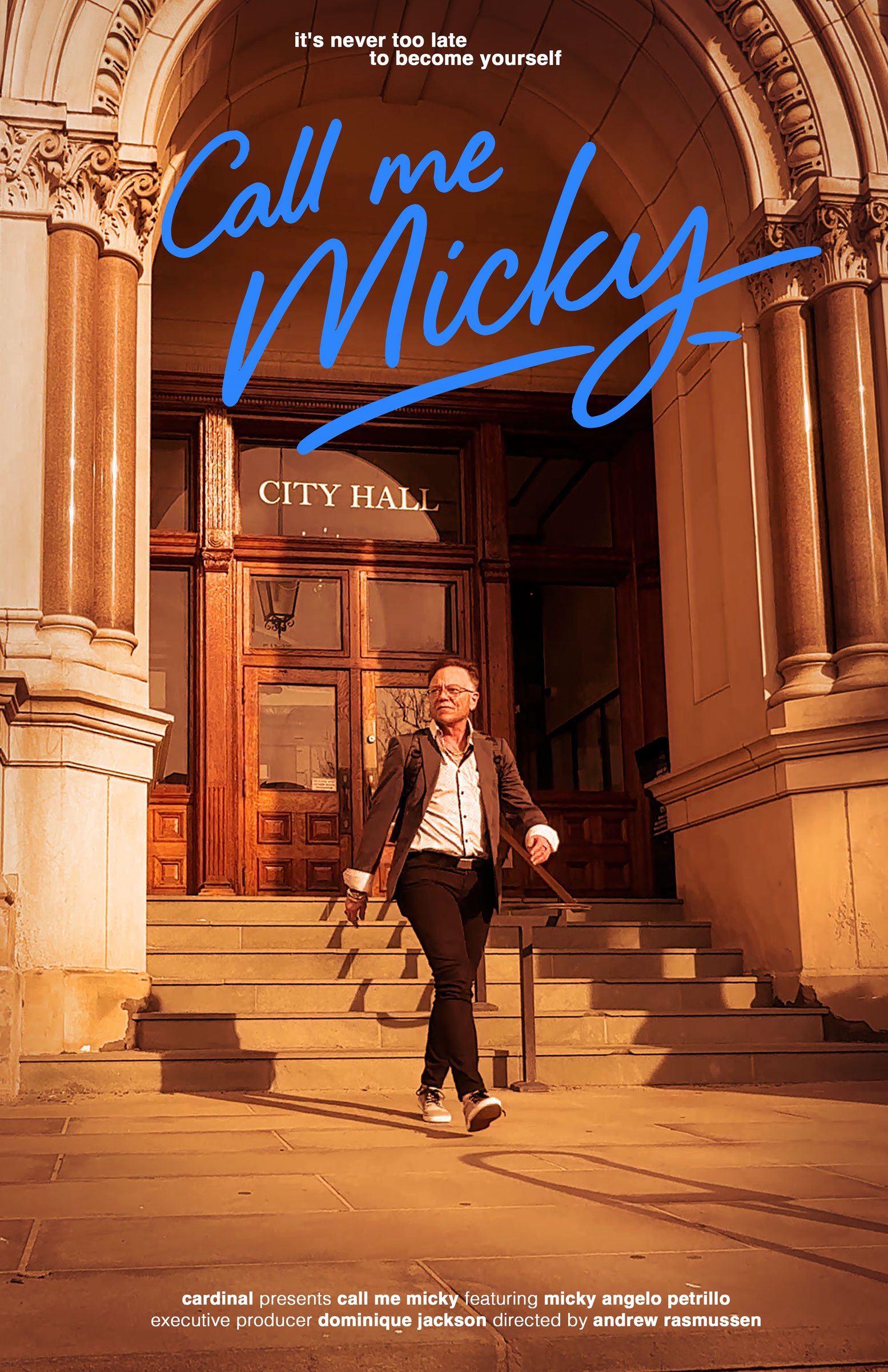
Directed by Andrew Rasmussen and executive produced by POSE star Dominique Jackson, this award-winning documentary delivers an unforgettable portrait of courage, reinvention, and one man’s extraordinary determination to live life on his own terms.
Some people spend their entire lives searching for happiness. Others spend decades hiding from the very thing that could finally set them free.
For Micky Angelo Petrillo, that journey took nearly 60 years.
In the extraordinary short documentary Call Me Micky, director Andrew Rasmussen introduces audiences to a man who has lived through more emotional turmoil, personal reinvention, and unexpected transformation than most people could imagine. Yet what makes this film so compelling isn’t simply the story of a transgender man who began living openly as his authentic self at 59. It’s the remarkable human being who emerges on the other side.
Funny, outspoken, vulnerable, occasionally outrageous, and thoroughly impossible to ignore, Micky Angelo Petrillo is the kind of documentary subject filmmakers dream of discovering.
And once you’ve met him, you won’t easily forget him.

A Documentary That Refuses to Play by the Rules
There are plenty of documentaries about personal identity, transformation, and overcoming adversity. Some approach their subjects with solemn reverence, carefully guiding audiences toward predictable moments of inspiration.
Call Me Micky takes a refreshingly different approach.
Rather than turning Petrillo into a symbol or reducing his life to a series of difficult experiences, Rasmussen allows him to be gloriously, unapologetically himself.
And Micky is quite a character.
A longtime New Jersey businessman with an unmistakable personality, Petrillo approaches his new chapter with a mixture of determination, nervous excitement, infectious humor, and an almost childlike enthusiasm for experiences he never imagined having.
We accompany him through open-mic performances, public appearances, new friendships, and the sometimes awkward experience of discovering how the world responds when you’ve finally stopped pretending to be someone else.
There’s nothing particularly polished about Micky’s journey, and that’s precisely what makes it fascinating.
He’s not a carefully manufactured inspirational figure delivering rehearsed speeches about courage. He’s a real person figuring things out as he goes along.
Sometimes he’s confident. Sometimes he’s frightened. Sometimes he’s hilarious.
And sometimes, beneath all that considerable personality, you can see the emotional weight of a lifetime spent struggling to understand where he belonged.
The film’s greatest achievement is that it allows all these different versions of Micky to exist together.

The Man Behind the Personality
For all its humor and energy, Call Me Micky contains moments of genuine emotional gravity.
Petrillo speaks candidly about the struggles that shaped his earlier life, including painful family relationships, profound unhappiness, and periods when his future seemed almost impossible to imagine.
These revelations give the documentary an emotional dimension that extends far beyond the mechanics of gender transition.
Here is someone who spent decades building a life, operating a business, maintaining relationships, and participating in the ordinary routines of adulthood while carrying an extraordinary internal burden.
And then, at an age when society often expects people to begin slowing down, he made the decision to start living differently.
What resonates most deeply is the recognition that reclaiming your identity doesn’t magically erase everything that came before it.
The past doesn’t disappear. Old emotional wounds don’t instantly heal. Confidence doesn’t arrive fully formed.
Micky still has fears, insecurities, and unanswered questions.
But he’s moving forward.
That distinction gives the documentary its genuine emotional power. Happiness isn’t presented as a destination where every problem disappears. It’s something Micky is finally allowing himself to experience, sometimes for the first time.

Dominique Jackson Brings More Than Star Power
One of the film’s most meaningful relationships is between Petrillo and executive producer Dominique Jackson, the acclaimed actress and advocate celebrated for her unforgettable portrayal of Elektra Evangelista on FX’s groundbreaking series POSE.
Jackson’s participation gives the project considerable visibility, but her importance goes much deeper than celebrity recognition.
Her on-screen conversations with Micky reveal a relationship built around understanding, encouragement, and mutual respect.
Jackson brings the perspective of someone who has navigated public visibility and the challenges of living authentically in a world that doesn’t always make that easy.
She understands something essential about Micky’s journey: being seen is only the beginning. Being respected as a complete human being is what truly matters.
Their interactions give the documentary a warmth that no amount of carefully constructed narration could replicate.
There’s genuine affection here, and it shows.

Andrew Rasmussen Understands His Subject
Director Andrew Rasmussen deserves considerable credit for recognizing that the most fascinating thing about Micky isn’t simply his transition.
It’s his personality.
Working within a brisk 22-minute running time, Rasmussen builds an intimate character portrait that moves between humor, public performance, friendship, vulnerability, and moments of personal reflection.
The film’s lively, occasionally chaotic rhythm feels remarkably appropriate for its central subject.
Micky isn’t someone who moves quietly through the world, and the filmmaking doesn’t attempt to force him into an overly restrained documentary structure.
Instead, Rasmussen embraces the spontaneity of his life.
Particularly effective are the moments when Micky finds himself stepping into unfamiliar territory, whether facing an audience, participating in a photo shoot, or discovering new confidence through the encouragement of friends.
These experiences might seem relatively ordinary to an outsider, but in the context of Micky’s life, they carry enormous significance.
A first photo shoot becomes an opportunity to see himself differently.
An open-mic appearance becomes an act of courage.
A public speech becomes evidence of a voice that spent far too many years waiting to be heard.
Rasmussen understands that the most important transformations aren’t always the ones that make the biggest headlines.
Sometimes they’re found in the smallest personal victories.
A Story That Reaches Far Beyond Gender Identity
Perhaps the most impressive thing about Call Me Micky is how effortlessly it moves beyond the boundaries of any single community.
Yes, this is unmistakably a transgender story, and that perspective is central to its identity.
But reducing it to that description alone would miss much of what makes the documentary worthwhile.
At its heart, this is a film about lost time.
It’s about the opportunities we convince ourselves are no longer available, the dreams we quietly abandon, and the versions of ourselves we suppress because we’re afraid of what other people might think.
Who hasn’t wondered what life might have looked like if they’d made a different decision 20 or 30 years earlier?
Who hasn’t felt trapped by expectations, responsibilities, or the fear of disappointing someone else?
Micky’s circumstances may be uniquely his own, but the emotions surrounding them are strikingly universal.
And that’s where the documentary becomes something special.
Rather than asking audiences simply to understand a transgender man’s experience, it invites them to recognize something of themselves within it.

An Award-Winning Film That Deserves a Wider Audience
Call Me Micky has already earned significant festival recognition, including Best Documentary at the New York Transgender Film Festival and the Spirit of Pride Award at the Susquehanna LGBTQ Film Festival.
Those honors reflect the film’s ability to connect with audiences through storytelling that feels personal rather than manufactured.
Its next major appearance is scheduled for November 7, 2026, at the 21st Annual Teaneck International Film Festival in New Jersey, bringing Micky’s remarkable story back to the community where so much of his life has unfolded.
There’s something particularly meaningful about that homecoming.
For decades, Petrillo was known primarily as a local businessman. Today, his story is reaching film festival audiences and introducing people to a personality whose ambitions and creative possibilities appear to be expanding rather than diminishing.
And perhaps that’s the most exciting part of his story.
At 62, Micky isn’t looking backward at everything he’s missed.
He’s looking forward to everything that might still happen.
The Verdict: A Small Film With an Enormous Heart
If there’s one legitimate frustration with Call Me Micky, it’s that 22 minutes simply isn’t enough.
Just as the audience begins to understand the complexities of Petrillo’s relationships, his emotional history, and his rapidly evolving public life, the film is approaching its conclusion.
There is clearly enough material here for a feature-length documentary, and the unanswered questions about Micky’s future are almost as intriguing as the experiences that brought him to this point.
But perhaps that sense of unfinished business is appropriate.
Micky’s story isn’t finished.
In many ways, it’s only beginning.
What Rasmussen and his collaborators have created is a moving, funny, refreshingly human documentary that understands something many larger productions forget: the most compelling stories don’t always require extraordinary circumstances.
Sometimes they simply require an extraordinary person willing to tell the truth.
Micky Angelo Petrillo is that person.
He may have spent nearly six decades waiting to introduce the world to the man he always knew himself to be, but he’s certainly making up for lost time.
And after watching Call Me Micky, one thing becomes abundantly clear.
The world hasn’t heard the last of Micky Angelo Petrillo. Not even close.
Final Verdict: Call Me Micky is an engaging, heartfelt, and unexpectedly entertaining documentary that balances genuine emotion with irresistible personality. Director Andrew Rasmussen delivers an intimate portrait of reinvention, while Dominique Jackson’s involvement adds warmth and perspective to an already compelling story. It’s a film that leaves audiences smiling, thinking, and wishing they could spend just a little more time with its unforgettable subject.
Film Information
- Title: Call Me Micky
- Director: Andrew Rasmussen
- Executive Producer: Dominique Jackson
- Production Company: CARDINAL
- Running Time: 22 minutes
- Festival Awards: Best Documentary — New York Transgender Film Festival; Spirit of Pride Award — Susquehanna LGBTQ Film Festival
- Upcoming Screening: November 7, 2026 — Teaneck International Film Festival
Official Website: https://www.CallMeMickyFilm.com